Changing Gear: Call for music creators
What is Changing Gear?
Changing Gear is YSWN’s new programme offering emerging music creators based in Yorkshire and the Humber commissions, equipment and support to develop and perform exciting new works.
In the first year, three women and minority gender creators working across a range of genres will be selected to compose and perform new music inspired by electronic music pioneer Daphne Oram, in celebration of the 100th anniversary of her birth in 2025.
What is involved?
If you are selected, you will be commissioned to create a new piece of electronic (or primarily electronic but featuring vocals and/or other instruments) music that takes inspiration from the life, work and legacy of Daphne Oram. This might involve exploring the sonic technology that she used and developed, her achievements with the BBC Radiophonic workshop and as a solo composer, her ideas around how humans interact with sound – or any other angle that sparks your creativity.
We have partnered with the National Science and Media Museum in Bradford and each creator will be invited to discover items in the collections relating to sound technology which could be used as a source of inspiration (although as they are museum objects you won’t be able to actually play them). We will also offer an opportunity to access and experiment with vintage sound equipment – for example analogue synthesisers, tape machines and effects units – and are excited to see how kit from decades past might interact with your present-day artistic voice.
We picture the new work being around 10-20 minutes in length (or in total, if made up of shorter parts or songs). You will perform the new work twice in spring 2025: first at an event at the National Science and Media Museum after it has opened following refurbishment and coinciding with the Bradford City of Culture 2025 programme, and then at an event in the Calder Valley which will coincide with a tour date for the Oram Awards’ own celebrations of Daphne Oram’s centenary.
What support is offered?
If selected, you will receive a fee of £1,400 for your participation in the programme – including time developing, composing and performing your piece, as well as receiving mentoring.
YSWN will cover your travel and accommodation costs (where needed) for the two performance dates, as well as for the visit to the National Science and Media Museum.
We also have a budget to help with sourcing vintage kit, which we will try to tailor to each music creator’s plans. We may arrange a ‘residency’ where all composers can meet and experiment together with equipment, in which case we will again cover your travel and accommodation costs where needed.
Each selected creator will benefit from six hours of mentoring over the course of the programme, delivered jointly by one of YSWN’s freelance Associates (including musicians, producers, sound engineers and DJs) and, thanks to our partnership with the Oram Awards, by an artist from their pool of fantastic past award winners.
Who can apply?
Changing Gear is open to women (cis or trans) and people of minority genders aged 18 and over – there is no upper age limit.
You will be based in Yorkshire and the Humber. This means either living here permanently, or if you are a student, it is your previous/holiday address, or your term-time address if you will still be studying here in 2024/25. We want to encourage applications from the Bradford postcode area and one of the three places will be reserved for Bradford creators. We particularly welcome applications from those of the global majority and Disabled people. An access fund is available to support successful Disabled applicants.
As a PRS Foundation Talent Development Network Partner supported by PPL, we will target this opportunity at emerging creators. You will probably already be making your own electronic music in any genre, perhaps at home, but it won’t yet have been widely performed in a professional context. Or maybe you primarily create using acoustic instruments or vocals but have some experience of electronic music and want to develop those skills further with support from your mentor.
We aim to work with a diverse group of music creators whose work may encompass genres such as electronica, contemporary classical, urban, jazz and experimental musics.
How do I apply?
To apply for Changing Gear, fill out the following Google form, which asks questions about you, your music and how you hope to benefit from the programme:
Changing Gear 2024-25 application form
If you would prefer to submit a video application, please answer the questions from the form in a short video and send it, along with the requested music links, to info@yorkshiresoundwomen.com.
The closing date is 11.59pm on Tuesday 10 September 2024.
A panel from the YSWN team, the programme partners and one guest musician will assess all of the eligible applications and be in touch with both successful and unsuccessful applicants by the end of September 2024.
We anticipate that the visit to the National Science and Media Museum will take place on a mutually agreed date in October or November 2024, and any days for experimenting with kit will be between November 2024 and January 2025. The two performances will take place between March and May 2025.
What if I have a question that isn’t covered here?
Email us at info@yorkshiresoundwomen.com and we will help.
About Daphne Oram
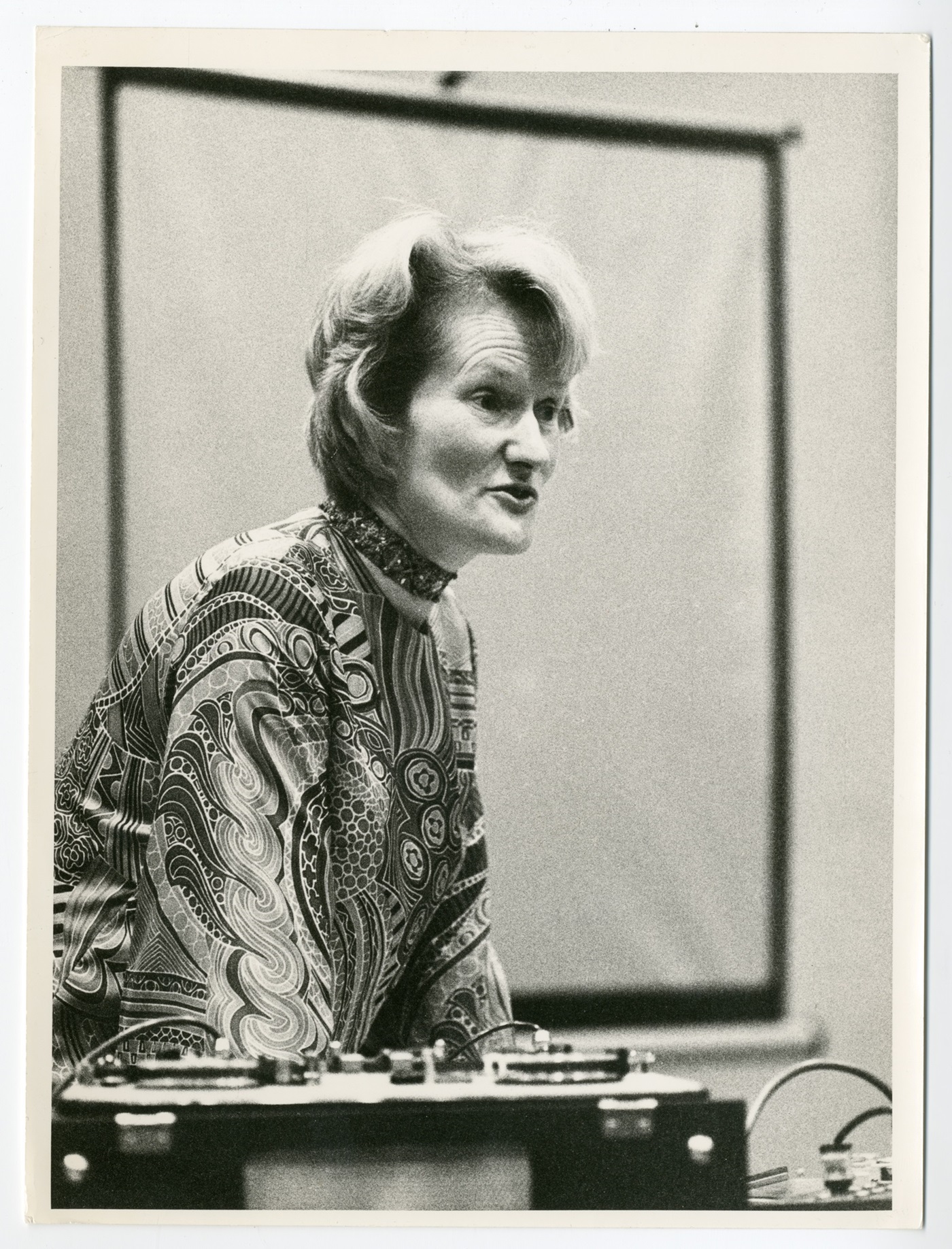
Daphne Oram giving a presentation at East Surrey College, Redhill in 1980. Photo: Keith Harding. Image provided by Special Collections & Archives, Goldsmiths University of London with permission from the Daphne Oram Trust.
Daphne Oram (1925-2003) turned down a place at music college in favour of joining the BBC as a junior studio engineer. In 1957 she co-founded the Radiophonic Workshop, which was set up to provide sound effects for BBC programmes but came to be recognised as one of the leading creative hotbeds of early electronic music, with Delia Derbyshire, Maddalena Faggandini and John Baker among the many composers who (usually anonymously) made innovative music using tape manipulation, oscillators and rudimentary effects.
Despite creating pioneering works such as the radio play soundscape Private Dreams and Public Nightmares, Daphne felt frustrated working within the confines of the BBC and left the Radiophonic Workshop in 1959 to found her Oramics Studios for Electronic Composition in Kent. As well as soundtrack work, over the following decades she collaborated with engineers to develop a prototype for the Oramics Machine, an ambitious instrument that would allow users to sculpt sound in the form of visual patterns on film strips. Along with her 1972 book An Individual Note of Music, Sound and Electronics, these experiments led her to explore more philosophical avenues around the connections between sound frequencies, acoustics and human experience.
As guardians of her archive, the Daphne Oram Trust is the best place to learn more about Daphne’s music and legacy, while the National Science and Media Museum’s parent organisation the Science Museum has further information and holds several key objects from her career.
About YSWN
Yorkshire Sound Women Network is a Yorkshire-based community interest company working nationally to champion gender equity in audio. We inspire and enable women and people of minority genders to explore sound and music technology, running projects devoted to artistic development, education and network-building. We also work with the audio industry to promote equality, tackle discrimination and increase opportunities.
YSWN is a PRS Foundation Talent Development Network Partner supported by PPL.